Managing state effectively is crucial for building robust and scalable React applications. With several state management solutions available, choosing the right one can be challenging. In this post, we’ll compare three popular state management libraries for React: Redux, Context API, and Recoil. We’ll also touch on other state management solutions available for React and React Native, providing a comprehensive comparison to help you make an informed decision.
Redux
Overview: Redux is a predictable state container for JavaScript applications. It helps you manage the state of your application in a single, centralized store, making state changes predictable and easier to debug.
A strong tool for managing state: Redux is a powerful tool that provides an unambiguous framework and support for managing state of any complexity.
Scalability: Redux allows you to efficiently scale applications, providing a stable and predictable architecture, which is important as the volume and complexity of the project grow.
Extensive community support: Redux is highly popular among developers, providing an active community, regular updates, documentation, and support.
Overcomplexity: Redux can be too complex for some simple applications, which can lead to overburdening in terms of coding and setup.
Potential overhead: Redux can have a lot of boilerplate code, especially in the initial setup, which can lead to redundant code and complexity.
Thunk/Saga is used to improve asynchronous kodos
Weekly downloads: ~10mil (Redux), toolkit – 7.5mil, and other – 800k-1.2mil – so there is really wide dev usage
Key Features:
- Single store for the entire application state
- Predictable state updates with pure reducers
- Middleware support for asynchronous actions
- Strong ecosystem and developer tools
Pros:
- Predictable state management
- Powerful developer tools (Redux DevTools)
- Large community and extensive ecosystem
Cons:
- Boilerplate code can be overwhelming
- Requires understanding of Redux concepts (actions, reducers, middleware)
GitHub: Redux
Context API
Overview: The Context API is a built-in feature of React that provides a way to share values between components without passing props through every level of the component tree.
Key Features:
- Prop drilling elimination
- Easy to use and integrate
- Lightweight solution for state management
Pros:
- Simplicity and ease of use
- No additional libraries required
- Great for small to medium-sized applications
Cons:
- Not suitable for complex state logic
- No built-in support for side effects (like Redux middleware)
GitHub: React
Recoil
Overview: Recoil is a state management library for React that provides a flexible and efficient way to manage state. It aims to offer the best parts of both Redux and Context API while introducing new features like atoms and selectors.
Trendy: It is quickly gaining popularity
Easy to understand, because it looks like a custom hook and the usage is the same as the usual useState, but it is global.
Community size: Small community, correspondingly less understanding from the developers
It is more difficult to work with middleware. Accordingly, you need to write more code to handle the state change
Weekly downloads: 800k
Key Features:
- Atoms for state units
- Selectors for derived state
- Easy integration with React Suspense
- Concurrent mode compatibility
Pros:
- Minimal boilerplate
- Powerful and flexible state management
- Concurrent mode support
Cons:
- Relatively new with a smaller community
- Less mature ecosystem compared to Redux
GitHub: Recoil
Other State Management Solutions
MobX
Overview: MobX is a simple, scalable state management library that uses reactive programming principles to manage application state. It automatically tracks state changes and updates the UI efficiently.
Ease of use: MobX is based on the concept of observers (observers) and reactive changes, which allows you to focus on the logic of the application, and not on the details of state management.
Less boilerplate code: MobX’s approach to state management reduces the need to manually code declarative actions and reactions to state changes.
Automatic tracking of state changes: MobX tracks dependencies between data and automatically updates components when state changes occur.
Potential Difficulty in Understanding: Although MobX offers a simple API, its concepts such as observers and reactive changes can be difficult for beginners to understand.
Relative lack of community support: Compared to other libraries, MobX may have less resources, documentation, and an active community, which may delay solving problems or getting help
Using a class to initialize a page
Weekly downloads: 1.2 million
Pros:
- Minimal boilerplate
- Reactive state management
- Easy to learn and use
Cons:
- Can lead to less predictable state changes
- Smaller community compared to Redux
GitHub: MobX
Zustand
Overview: Zustand is a small, fast, and scalable state management solution for React. It provides a simple API with minimal boilerplate and supports both simple and complex state logic.
Lightweight and easy-to-use state container: Zustand offers a minimalistic approach to state management, perfect for simple applications or cases where Redux might be too heavy.
Less complexity compared to Redux: Zustand provides a simple API that allows you to focus on the core functionality of your application without spending time configuring complex Redux configurations.
Support for asynchronous operations: Zustand can handle asynchronous operations without the need for middleware, which simplifies the implementation of functionality that requires asynchronous communication.
Limited features compared to Redux: Zustand offers fewer features compared to Redux, which may not be enough for some complex application scenarios.
Less popularity and resources: Compared to Redux, Zustand may have fewer resources, a less active community, and a limited number of supporting libraries or extensions.
Weekly downloads: ~3.2mil
Pros:
- Minimal boilerplate
- Simple and flexible API
- Fast and efficient
Cons:
- Smaller ecosystem and community
GitHub: Zustand
Comparison Table
| Feature | Redux | Context API | Recoil | MobX | Zustand |
|---|---|---|---|---|---|
| Ease of Use | Moderate | Easy | Easy | Easy | Easy |
| Boilerplate Code | High | Low | Low | Low | Low |
| Community Support | Large | Large | Growing | Medium | Small |
| Middleware Support | Yes | No | Yes | No | No |
| Side Effects Handling | Yes (Redux Thunk, Redux Saga) | No | Yes | Yes | Yes |
| DevTools | Excellent (Redux DevTools) | None | Basic (experimental) | Basic | Basic |
| Scalability | High | Medium | High | Medium | Medium |
| Concurrent Mode | Partial | Yes | Yes | No | Yes |
State management in Ethora engine
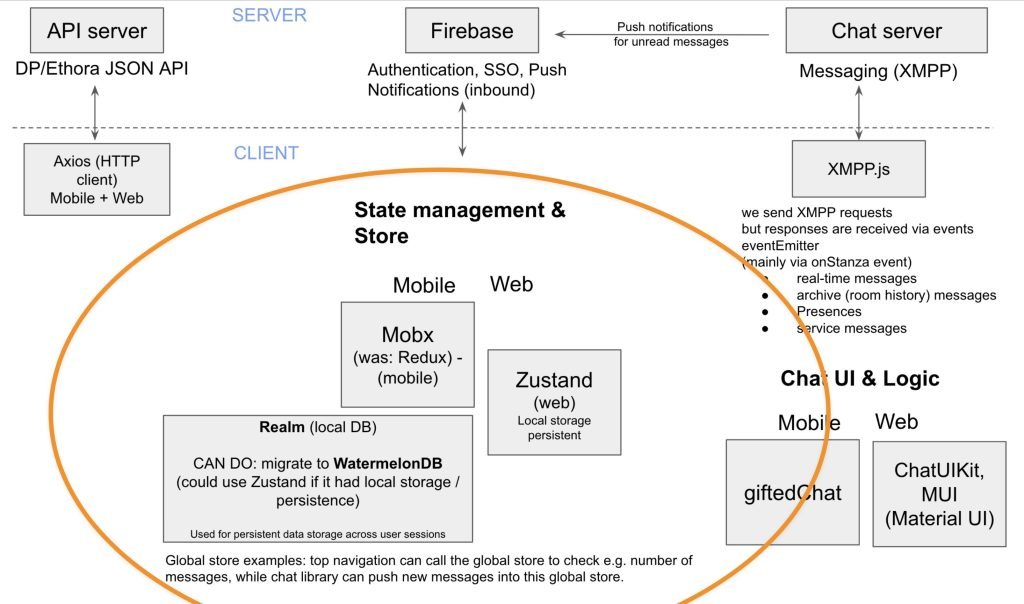
In Ethora engine previously we have previously migrated from Redux to MobX in our React Native version, also using Realm as a local database storage. In Web version we use Zustand as it supports a persistent local storage across different user sessions in the browser.
There is a global store or store of stores concept in our architecture. For example, top navigation can call the global store to check a number of messages, while chat library can push new messages into this global store. Global store can include stores of specific chat rooms which in turn store relevant chat history.

In our latest version of Ethora Chat Component we decided to use Redux again and we will take a view regarding whether we would like to change our store for the web version too.
Ethora developers team thinks it’s best to use Redux because it’s the most popular and developed library for state management. Also, it can often be used uniformly for React.js and React Native. Our second favourite is Mobx, but since it’s written with a class approach and has little community support compared to others, we wouldn’t recommend it.
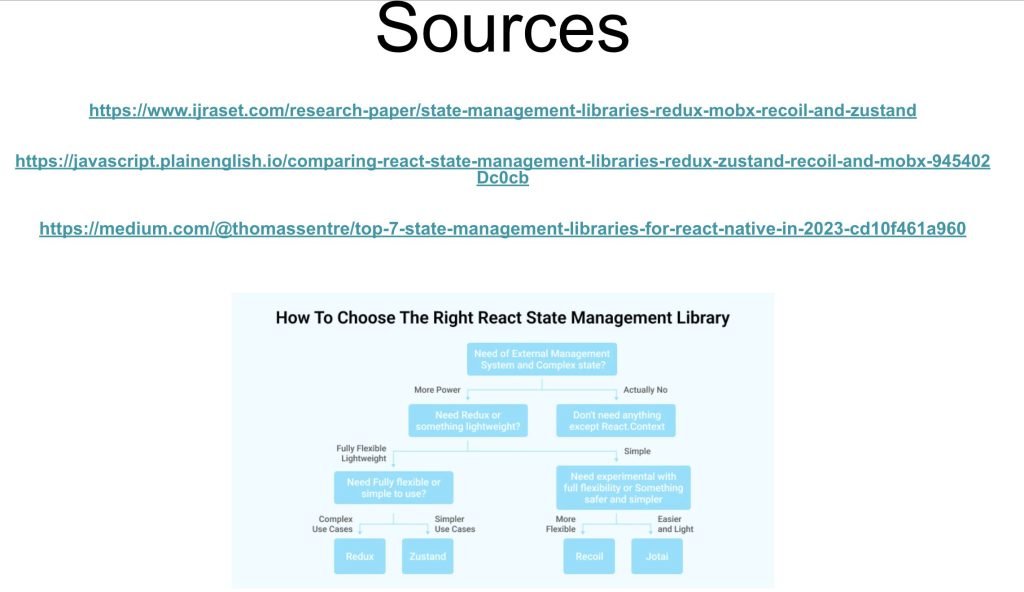
Sources of our research by Roman Leschuh:
Conclusion
Choosing the right state management solution for your React application depends on your specific needs and the complexity of your state logic.
- Redux is a powerful and mature solution, ideal for large-scale applications with complex state requirements and a need for robust developer tools. It is also the preferred choice by Ethora team.
- Context API is perfect for simpler state management needs and smaller applications where prop drilling is a concern.
- Recoil offers a modern approach with minimal boilerplate and is well-suited for applications that can benefit from concurrent mode and flexible state management.
- MobX and Zustand are excellent alternatives if you prefer reactive state management or a more lightweight solution with minimal setup.
Evaluate your project’s requirements, team familiarity with each library, and the ecosystem to select the best state management tool for your React application. Each of these solutions has its strengths and can significantly enhance your development workflow when used appropriately.